A Parent's Guide to the PICU




Three years ago, when we were in the NICU, Jodie wrote a post for parents faced with being in the NICU, Dear New NICU Parents. It occurred to me as we went through the process of flying Chloe over last week that a similar guide might be helpful for parents admitting their child to the Pediatric Intensive Care Unit (PICU) for the first time. Unfortunately, I'm not nearly as good a writer as my wife, so my post will be a lot more technical! My prayer is that you will read this to get a window into our lives, and never experience it yourselves, but if you find yourself going through this process, maybe this post can help to relieve the stress of being confronted with a completely different world operating by its own rules, procedures, and rhythms. I'm writing this post specific to Children's Mercy Hospital in Kansas City, but I would imagine that other PICUs are similar, though the times and rules might change depending on where you are.
The ER and Transport
Unless you're in Kansas City and go directly to the Children's Mercy Emergency room, your first experience will be at your local emergency room. If the ER doctor feels that they need to transfer your child to Children's Mercy, they will talk with one of the intensivists (attending physicians), and initiate the transport process. Unless they directly transport your child via ambulance, this will mean flying over, either by helicopter or by plane. In our case, Manhattan is right on the edge of the range for a helicopter, so travel is usually via plane (she's gone on the chopper once). Once you hear that this is the direction they are going, be ready to be patient. Once activated, the Children's Mercy flight team will prep, then travel via ambulance to the downtown Kansas City airport. Once there, they will fly to the nearest airport (in our case, the Manhattan airport), and the local EMS will bring the Children's transport team to the ER. This whole process usually takes anywhere from 1.5 to 2 hours before the flight team arrives at the hospital. Once they arrive, things descend into chaos a bit (even for us). One member of the team (usually there are four) will get report from the ER nurse, while another will assess your child and get information directly from you. The ER will have you sign discharge papers to discharge to the local EMS, the local EMS will have you sign something consenting to transport your child and discharge to the Children's Mercy flight team, and the Children's Mercy team will have you sign consent forms to transport via air. Whether or not you can ride in the plane with your child depends on a number of factors. Essentially, the plane has a weight limit, and so figuring on equipment, team (if you were in wrestling in school, and loved weigh-ins, this may be the job for you!), and your child's weight, they will let you ride along if you're under a certain weight.
Once they have your child ready to go, you say goodbye (this never gets easier), and they head out. The local EMS will drive the team to the airport, then they fly over, take the Children's Mercy ambulance to the hospital and admit your child to either the floors or the PICU. "The floors" are what Children's Mercy folks call the inpatient rooms on floors 4,5 and 6 in the hospital. The floors are a little more relaxed than the PICU, but many of the things (like rounds) from my PICU explanation will apply to the floors. One huge difference is much looser visiting rules and the presence of a bathroom with a shower in your child's room on the floors. In theory, if your child is admitted to the floors, you could conceivably stay in the room with your child. If you're in the PICU, unless it's only for a night, you're going to want a room either at the Ronald McDonald Room or one of the Ronald McDonald Houses (more about that later). Transport and getting your child admitted takes a bit more time than it took the transport team to get to you (they move a little slower when taking care of a child), so however long it took to get to you, tack on an hour or so before you are actually able to see your child. We usually have time to go home, pack, and drive over to arrive at about the same time that Chloe gets settled in.
Your First Visit to the PICU
When you arrive at the PICU, you're going to want to get straight in to see your child. I encourage you to again prepare to be patient. Once you find a parking spot. . . . Pro tip: there are four levels, so unless you see an obvious open spot, just keep going down. Unless you're there at night, the chances of finding a spot on blue are almost non-existent, red is rare, maybe on yellow, and probably on purple. If the hospital is really busy, you might even end up down on turquoise. When you get on the elevators, grab a card to remind yourself where you parked (unless you love to wander around a parking garage hitting the horn button on your key fob). Don't forget to bring your ID with you, you'll need it to get through security. Sometimes the hospital can be a confusing maze, don't be shy asking for help. When you get off the parking garage elevators, there is a set of elevators right when you walk in. Those go to the day clinics. Just keep walking. You want to keep going until you get to a security check-in. They will help you find the rest of your way.
Once you get up to the PICU, you will have to sign some paperwork, and they will go over the visiting rules with you. Here's the cliff notes version. You cannot have food back in the room, but you can have a drink if it's in a sealed container (coffee with a lid counts). I'll spare you the shocking moment now, they only have diet pop in the hospital. So, no matter how hard you look, you will never find a drink with real sugar. Visiting rules feel a little quirky. Your child can have two primary visitors (for many families, this will be the two parents). Beyond those primaries, only two people can visit back in the room at a time, for a total of four people in the room. Underage children don't count, so if you have other kids, they can come back to the room with you as long as they are fever/cough/sniffle free. Visiting hours can feel a bit weird, but the reason will become clear. The two primaries can visit at any time, day or night. Other visitors (including minor children) can visit from 8 am to 7 pm and 8 pm to 9 pm.
Getting in the Room
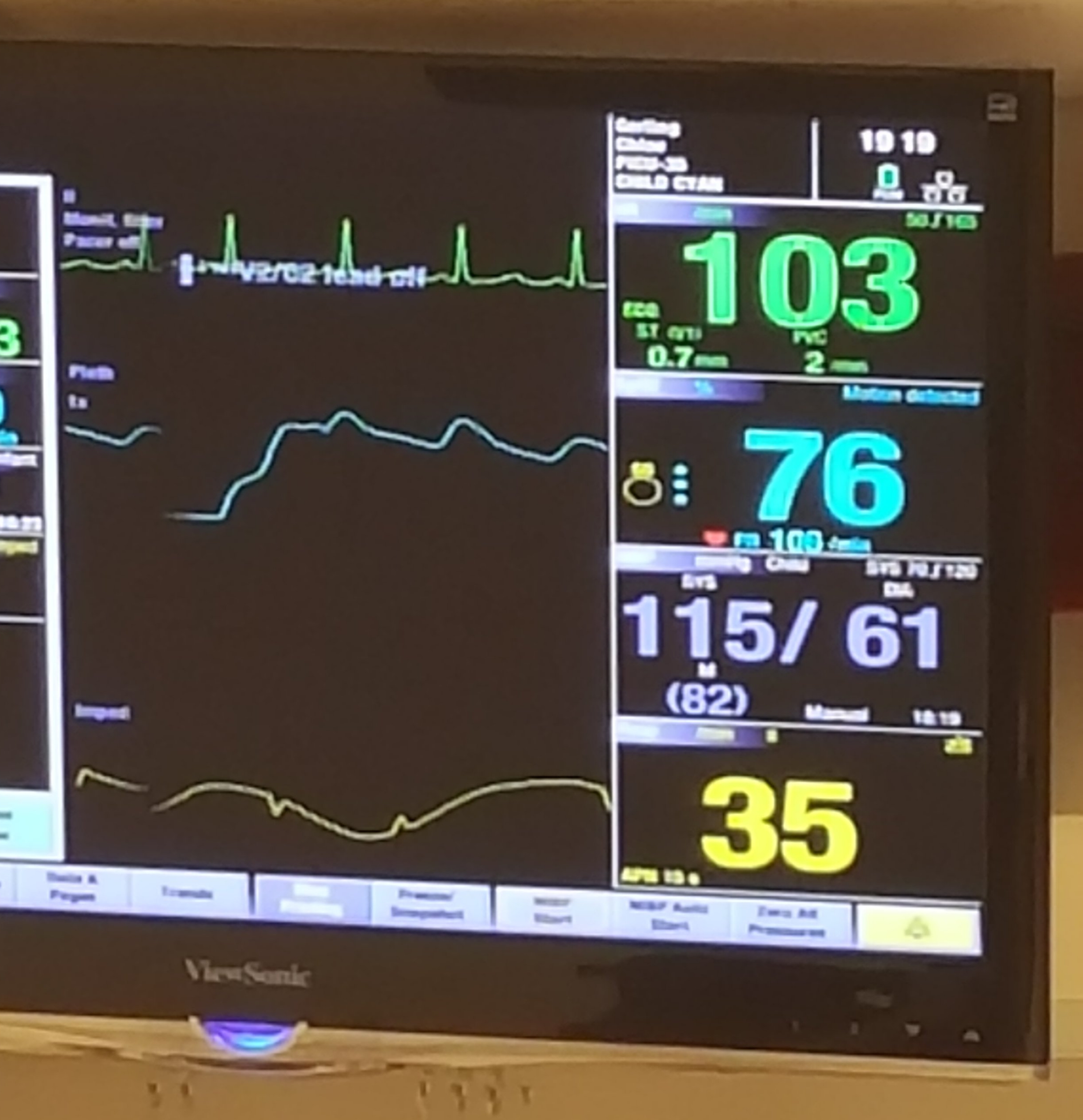
Once you get to the room, you'll be confronted with a very different world than you're used to. Most likely, your child will be in a private room. The (all glass) door will be open, and all of the lights will probably be on. Most of the time, your child will be one of two patients for your nurse, and he/she will divide his/her time between the two rooms (hence the room door being open all the time). You'll notice lots of monitors, beeps, cries from other rooms, doctors and nurses talking, and more beeps. Did I mention the beeps and alarms? Frankly, it can all feel a bit overwhelming, After a while, you learn what all of the beeps and alarms mean. A good rule of thumb is to observe your nurse. If there is an alarm going off and he/she seems unconcerned, it probably is just something not reading correctly. If you aren't sure, you can always ask. As I mentioned, your nurse will have two patients, so when you're looking at the monitor, you'll see two sets of numbers. The left side of the monitor contains the vital signs for the nurse's other patient, and the right (bigger) side is your child's vital signs.
Working down the monitor, the top number is your child's heart rate. Next is your child's blood oxygen saturation level. Unless you have a heart kiddo, this number will be in the 90s. A number in the 70s like Chloe's would constitute an emergency. Next is the latest blood pressure in white/gray. If there is a red blood pressure number there, your child has a line in an artery measuring a "live" accurate blood pressure. The bottom line is breath rate. My observation is that this number tends to not detect the best. If the alarm sounds and the yellow number is the problem, look at your child before panicking. Again, a good rule of thumb is to observe the nurse's reaction.
Another good thing to keep in mind is that the nurse is going to be operating on a completely different schedule and set of rules than you might be used to. I have seen lots of parents get angry at nurses and frustrated at the pace of attention in the PICU. Remember that there are lots of kids in the PICU, and some of them may require immediate critical care. For example, if there is a code or an admission to the hospital, rounds will typically stop so that the doctor can focus his/her attention on the urgent situation.
Shift Change and Rounds
You'll find that the hospital functions on a day/night cycle. Most nurses work three twelve hour shifts in a row. Day nurses and night nurses tend to stay day nurses or night nurses. The flow of days looks very different from the flow of nights, so in a way, nurses are specialized to one or the other. The nurse shift change is at 7 am and 7 pm. Somewhere between 7 and 8, the nurses will give report to the next nurse on shift. Because they are discussing your child's information, and to keep things calm during this exchange of information, visitors (other than the primaries) aren't allowed back in the room during shift change.
The next super important time to understand is morning rounds. Starting at 9:00, each intensivist and their team will visit each patient to talk about medical status, concerns, plan for the day, etc.. Rounds rarely start in the same place, so it's kind of waiting for the cable guy. To not miss rounds, you need to be in your child's room between 9 and noon. Most of the time, this is the only time you may see the doctor during the day, so it's really important to be there. The rest of the day, you'll mostly interact with the nurse, and occasionally a resident or fellow. What rounds looks like is a bunch of people walking around with computers on wheels (cows). When they get to your room, you'll see 5-10 people standing there. The team typically will consist of the attending physician, one or more residents and maybe a fellow, a nurse practitioner, a pharmacist, a dietitian, maybe a social worker, a cardiologist or other person important to the care of your child. The attending doctor (or intensivist) will probably introduce him/herself, but the rest of the team won't.
When the rounds get to your room, one person will begin to review the medical profile and status of your child. This usually (but not always) is a resident. After that, the team will discuss status, care concerns, a possible plan for the day, etc.. The attending doctor might ask you a question or two. During all of this, it's best to follow the old rule, speak only when spoken to. I recommend just listening carefully and observing how rounds work. You may not understand everything, but be patient! After all of this discussion, the doctor will ask if you have any questions or concerns. Your patience has been rewarded! Now is the time to ask questions or let the doctor know if you have any concerns about your child's condition. Again, this is the time to talk to the doctor. If you miss rounds, don't get really frustrated if you have trouble seeing the doctor to ask questions. They are spending most of their day managing chaos, and if your child is fairly stable, they may not have time to come back to the bedside.
Residents, Fellows and Attending Physicians, Oh My!
Let's all be honest, unless you've gone to medical school, the designations for the various folks in the hospital is really confusing. Particularly confusing to me was the difference between residents, fellows, and intensivists. Once again, here's the cliff notes version! A resident is someone who has finished their four years of medical school and is now getting site specific training in a particular field. For example, several of the Pediatricians in Manhattan did their residency here at Children's Mercy. The difference between an intern and a resident is that an intern is someone still in school getting training. A resident is actually earning a salary and has completed the schooling portion of their training. A fellow is a level up from a resident. A fellow has completed a residency and is now getting further specialized training in a specific field, usually with the goal of being an instructor at some point. Since Children's Mercy is a training hospital, most of the doctors are actually technically professors too, and all probably did a fellowship. The attending physician is the doctor ultimately responsible for the care of your child. These attending physicians rotate in for a week of twelve hour days. Going up the chain, if you have a concern, talk to your nurse. If that concern needs extra attention, he/she will probably talk to the resident, and so on up the chain. Working with the nurse are care assistants, resource nurses and the charge nurse. As all of these people interact with you outside of rounds, they will introduce themselves.
Tips for Hospital Life
First tip, and this one is really important. When you go to the cafeteria for breakfast 8:30 or earlier (remember rounds start at 9), skip the obvious lines and move yourself right over to the line where they can make you an omelet or breakfast burrito. It's worth it, trust me. Now that's out of the way, hopefully, if you're there for longer than a night, your social worker will have referred you over to the Ronald McDonald house. There are three houses you might stay in, Cherry St., Longfellow, or Wiley. Each house is unique and has its own charm. These houses are a great blessing and are a home away from home for our family. Jodie has written more about the Ronald McDonald house here.
Beyond the cafeteria, there is actually a Subway hidden away in the hospital. If you go looking for it, there's a decent chance you might get lost, but it is a nice addition to the hospital. It's on the 1st floor, in the green sector. If you're taking the castle elevators to the first floor, go left out of the elevators, all the way down the hall, turn left at the T, walk past radiology and around the corners, and you'll come to the day surgery entrance where the Subway is.
Probably the most important part of a prolonged stay at the hospital is taking care of yourself. As best you can, get a good night's sleep. Your child is in great hands with the wonderful nurses at Children's Mercy, so you can sleep. Walk down the hill and go to Crown Center. Take an afternoon/evening trip over to Taco Republic. Take the other kids to Legoland down the hill.